Your employees can do it in training, your customers play along in the loyalty programme, and back in everyday life both stop.
Whether it is workplace training, a pilot project, a serious game or a loyalty programme: inside the protected space the new behaviour reliably happens, outside it is cleared away again by defaults, incentives and metrics that nobody designed for it. That point is the transfer break, and Engaginglab builds the infrastructure that closes it.
invested by companies in Germany in workplace training each year (IW training survey)
34%
of what is learned is still applied after one year, as estimated by training professionals (Saks & Belcourt, 2006)
17 years
of behavioural diagnostics in organisations and customer programmes
The transfer break
New behaviour does not disappear, it gets outvoted.
Everyday life speaks louder than the seminar and louder than any points balance. Where it does so can be found, almost always at one of three points.
Defaults
The old way is the preset one, in the ticketing system just as in the ordering process. Anyone who wants the new way has to decide against the default every single time, until one day they stop.
Incentives
The old behaviour keeps getting rewarded, for employees through their target agreement, for customers through the discount that arrives anyway.
Visibility
Nobody sees whether anyone does it differently. What nobody sees does not count as normal, and what is not normal nobody does alone.
The category
Transfer infrastructure, not transfer management.
The market has known the problem for decades and almost always treats it at the level of the person. We treat it at the level of the environment, because employees and customers alike return afterwards to exactly the environment that produced the old behaviour.
Transfer management
Works on the person
Reminder emails and push notifications
Transfer coaching and learning buddies
More points, louder campaigns
Works as long as someone keeps reminding.
Transfer infrastructure
Works on the environment
Defaults in tools and processes
Incentives, approvals and metrics
Roles, rituals and visible norms
Works when nobody thinks about it any more.
In conservation, nobody who is serious simply opens the cage in the wild. You build an acclimatisation enclosure, not in the zoo but in the middle of the territory. Most programmes are hard releases, and we build the enclosure in the territory.
Where the break costs most
Two spaces you have probably already seen fail.
Employees
The training worked, Monday didn't.
400 employees at roughly € 1,347 of training per head comes to about € 540,000 a year. If the estimate of one third still applied holds, around € 355,000 of it stays in the seminar room. With compliance, liability is at stake as well.
Protected space: learning platform, workshop, serious game. Break: what do people do differently next Monday?
Customers
The points get collected, the buying behaviour stays the same.
A programme with 400,000 members that gains eight percentage points of activation creates around € 5.8 million in additional value at € 180 annual revenue per active member, without a single new member.
Protected space: the programme itself. Break: the behaviour lives only as long as the reward.
The same break shows up in change pilots, in software and AI rollouts and in customer onboarding.
The Drive Method
The five steps always apply, you only decide how deep we go with you.
Every transfer infrastructure is built along the same five steps. The offers below differ not in method but in the step at which your team takes over.
01
Diagnosis
We measure the gap between the desired behaviour and the signals your system actually sends.
02
Fit
Using the Behavioral Solution Matrix, we choose the tool that fits the motivational situation and rule out the obvious ones that don't.
03
Architecture
We build with the tool that fits the behaviour, from defaults and nudges through intrinsic design to incentives and goal setting.
04
Enablement
Your teams learn to run and extend the system themselves.
05
Management
The system becomes part of your metrics and governance, so that it stays.
Every diagnosis includes an authenticity check, because not everything from the protected space deserves an infrastructure.
Genuine
Holds without the frame. Here we build what carries it for good.
Frame-dependent
Lives only inside the programme. Here we build the bridge.
Illusion
Only performed, or would have happened anyway. We tell you before you invest further.
We sell no programmes and take no money from programme providers. That is why our findings can also say that the problem is not everyday life but the programme itself.
Name a specific behaviour from your organisation and answer 20 automatically adapted questions. The result is a zone reading in under ten minutes that shows whether the behaviour runs on “because I have to” or “because I want to” fuel, and with it, whether it is likely to survive the removal of supervision, points or the training setting or to vanish along with them, plus where the tension sits in your own answers and the one question the check deliberately leaves open.
free · under 10 minutes · your result is called the Misfit Score
The complete Diagnostic Report, gap analysis, intervention sequence, roadmap and objection cards for internal communication, is the level above: the Behavioral Systems Analyzer. The free check tells you whether that level is worth it.
The data shows: control produces compliance, not commitment. When people understand how their performance contributes to meaningful outcomes, they continue the behaviour without supervision.
Why control undermines intrinsic motivation
How to address these objections in your next presentation
Which data you need for decisions at leadership level
02 / Action Plan
30/60/90-Day Roadmap
Weeks 1 to 2Identify and eliminate supervision-dependent triggers
Week 3Document structural contradictions in the system
Month 2Connect behaviour to meaningful outcomes
Month 2Build feedback loops that make competence visible
Month 3Measure and calibrate self-sustaining engagement
01 / Gap Analysis
Moderate Misfit
Actual
External Regulation
"I do it because I have to."
Required
Identified
"I do it because it matters to me."
Structural Signals
Flag D · System-Reality GapOK
Flag C · Motivation ErosionOK
Flag S · Contradictory Signals!
Investment
What it costs, and what for.
A loyalty programme that gains 8 percentage points of activation rate through behavioral redesign generates, for 400,000 members at € 180 average annual revenue per active member, around € 5.8 million in additional value. The Behavioral Systems Analyzer costs € 9,500. That is 0.16% of the value it calculates.
Diagnosis & Prescription
Behavioral Systems Analyzer
The gap gets a number, the solution gets a direction.
€ 9,500
net · plus VAT · fixed fee
Results within ten working days
Within ten working days you know whether your programme will hold in everyday work, where it breaks, and which rule to change first. To get there, we read your programme, your target agreements and your processes, run the diagnosis with your leadership team and analyse which signals your system actually sends. The report delivers your validated Misfit Score, a gap analysis per examined behaviour, and the Behavioral Fit Compass: three prioritised interventions with reasoning and failure indicators, plus the exclusion protocol that records which obvious measures were deliberately rejected and why. The Objection Cards make the result defensible internally, including to the people who were not in the room.
Price lock: if you commission a design or a Residence within 90 days of delivery, the prices from the day of your assessment apply.
net · plus VAT · fixed fee by scope, set after the Analyzer
results in 4 to 6 weeks
Takes the Specification Sheet from the assessment as its ticket of entry and chooses, for each behaviour, the tool that carries it. Defaults go where the new way should be the preset one, nudges where everyday work only lacks a prompt. Intrinsic design applies where the activity itself can carry the behaviour, incentives and goal setting where they build it. The work happens with your team rather than around it, because the expression of an intervention requires context knowledge that lives inside your organisation and nowhere else.
Extended version with prototyping and pilot support for Journey design: from € 42,000. Both versions require a completed assessment.
✓Ongoing analysis of behaviour and improvement opportunities in operation
✓Capability building in your teams along the five competencies of behavioral design
✓Management system integration: the motivation system becomes part of your KPI logic instead of a parallel exercise
✓Strategic advisory, audits and ongoing system corrections
The decisive difference from Assessment and Design: at the end of the engagement, the capability stays in your organisation. Not as documentation, but as lived competence within your own teams.
Two quarters are two full KPI cycles, one measurement run plus one chance to correct. Four quarters make the built capability productive. The engagement ends, the capability stays.
Internal capability instead of external dependency.
The goal of a consulting engagement is not only that something changes, but that the organisation can continue to move forward under its own power. That works precisely when people internally are able to diagnose behaviour, design systems, and integrate this thinking into their daily work.
What makes change lasting is not the quality of the solution, but the environment in which people work afterwards, because the brain is a social calibration system that orients itself by what counts as normal in its surroundings.
The Behavioral Architects Masterclass is the environment in which this internal capacity develops: a year-long programme for HR professionals, leaders and consultants who want to anchor behavioral design not just as knowledge, but as a permanent way of thinking.
Roman Rackwitz decodes the mechanisms of sustainable performance. No myths, no motivational speeches, just architecture.
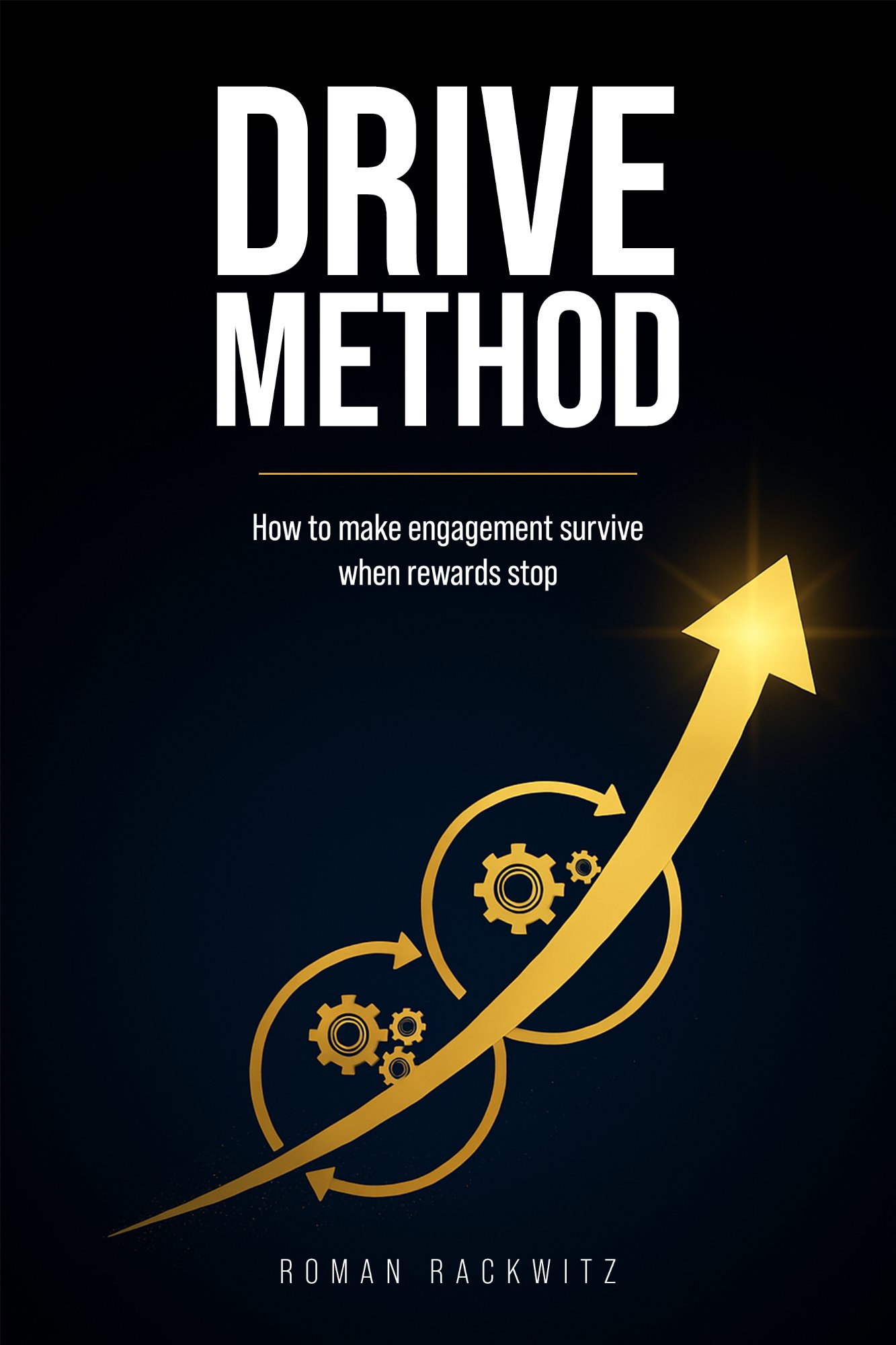
How to build engagement that survives even when external rewards disappear. A practical book for those who want to design systems rather than symptoms.
"Engaginglab gave us the decisive ideas around the gamification of our business model at a critical stage of development. I am very grateful."
Carsten SudhoffCEO CircularSociety & Chairman sqiyo AG
"Roman knows gamification inside out, back to front and upside down. It is clear that he lives it."
Nick TyrellCEO Osney Media
"Through targeted questions and his relaxed manner, Roman succeeded in bringing all participants up to speed and arriving at comprehensible results."
Daniel Wanschalöm JankeTechnical Co-Founder BRIVE
Trusted by, among others
SRF
SwissLife
Goethe Institut
SBB
Deutsche Bahn
Continental
Hanseatic Bank
Volkswagen
L-Bank
DFL
DeutschlandCard
Biontech
TheFatRat
smartsteuer
Westfalen
123tv
BGHW
Sustayn
Opera
Open Loyalty
Vorwerk
Cuju
& more
Frequently asked
What you want to know before we speak.
Most questions arise not from scepticism, but from the desire to make the right move at the right time. Here are the most common ones, including the uncomfortable ones.
Almost always with the Behavioral Systems Analyzer. Not because it is a cheap entry point into something more expensive, but because every subsequent engagement needs the assessment as its ticket of entry: the Behavioral Fit Compass selects interventions on the basis of a validated diagnosis, and a prescription without a diagnosis is not something we sell, at any price point. There are two paths after: Behavioral Experience Design for organisations that want to translate the three prioritised interventions into a working system, and the Behavioral Architect in Residence for organisations that want their behaviour analysed on an ongoing basis and capability building and management system integration anchored for good. The Residence also starts with the assessment, because without a diagnosis it would have nothing to anchor. If you commission either path within 90 days, the prices from the day of your assessment apply.
Because it is not a survey. The assessment is a guided diagnostic session with Roman Rackwitz personally, which activates, structures and translates the systemic knowledge within your organisation into a complete report containing the validated Misfit Score, a gap analysis per examined behaviour, BSM positioning maps and an executive summary for the leadership level. The Behavioral Fit Compass turns this into a prescription: three prioritised interventions with reasoning and failure indicators, plus the exclusion protocol documenting which obvious measures were deliberately rejected and why, which in internal budget discussions is often worth more than the recommendations themselves. Above all, the report contains a number: what the identified gap costs your organisation, and what a functioning system would be worth. For a loyalty programme with 400,000 members that gains 8 percentage points of activation rate through behavioral redesign, that is around € 5.8 million at € 180 annual revenue per active member. The assessment costs € 9,500. The ratio speaks for itself.
Results of the Behavioral Systems Analyzer are delivered within ten working days. On your side it takes a guided diagnostic session with the leadership team, plus brief preparation beforehand. Behavioral Experience Design delivers the finished system within 4 to 6 weeks; your team takes part in workshops and design sprints, because the context knowledge lives with you. The Behavioral Architect in Residence runs for a minimum of two quarters, because whether the integration with your management system holds can only be proven after two full KPI cycles; the recommended term of four quarters makes the built capability productive.
It means that your own teams are capable, after the engagement, of diagnosing behavioural problems independently and designing behavioural interventions independently. Concretely: your HR team identifies a behavioral misfit in the onboarding flow without external help. Your loyalty team identifies which programme mechanic is sending the wrong signals and which intervention should take priority. This happens not through a report someone leaves behind, but through knowledge transfer, structured collaboration on real problems and the gradual handover of diagnostic and design tasks. Anyone who still needs Engaginglab for every intervention after the engagement is not a success case.
If a design or a Residence is commissioned within 90 days of report delivery, the prices from the day of your assessment apply, even if they have changed since. The assessment is not a gateway for an upsell logic, but a standalone deliverable with its own fixed price. Whether further collaboration follows is determined solely by what the report shows.
The Behavioral Architect in Residence is the right format for organisations that do not want to solve a single problem, but want to build the lasting capacity to identify and design behavioural problems independently. It is not an ongoing service to be consumed, but a function that is gradually shifted from outside to inside. Right for: organisations that regularly make new behavioral design decisions, whether loyalty mechanics, onboarding flows or incentive structures, and who do not want or cannot create a dedicated full-time role for this. It includes ongoing analysis of how behaviour develops in operation and where it can be improved. The minimum term of two quarters is enough to anchor the methodology, four quarters to make the capacity productive.
Yes. The assessment does not measure whether you are actively investing in engagement, but whether your system is sending the right signals. Running programmes can be part of the diagnostic picture, and frequently this is precisely where the core of the problem appears: the measures are well-intentioned, but the system around them remains unchanged, so the measures dissipate or even produce the opposite effect. The assessment makes this contradiction visible and provides a clear assessment of whether the running programme should be repaired or fundamentally reconceived.
Transfer infrastructure is the term coined by Engaginglab for the designed environment that carries new behaviour from a training, serious game, pilot project or loyalty programme into everyday life: defaults in tools and processes, incentives, approvals, metrics, roles and visible norms. Unlike transfer management, which works on the person through reminder emails, transfer coaching or learning buddies, it works on the environment that employees and customers return to afterwards. The point at which behaviour breaks off without this infrastructure is what we call the transfer break.
Professional exchange yes, commercial ties no. We sell no programmes, take no commissions and have no share in the revenue of programme providers. Only that way can our findings in your organisation also say that the problem is not everyday life but the programme itself, and only that makes them worth anything to you.
Contact
Setting the baseline.
Whether training, loyalty programme or leadership decision: the conversation always begins with a concrete behaviour that needs to arrive in everyday life, not with an offer.
The contents of this website have been prepared with the greatest possible care. However, no guarantee can be given for the accuracy, completeness and timeliness of the content.
When you visit this website, technical access data (IP address, browser type, access time) is stored in server log files for a maximum of 30 days for the purpose of secure operation. Hosting provider: 1&1 IONOS SE, Germany.
Cookies
This website does not use tracking cookies. Technically necessary cookies may be set by the hosting provider.
Contact enquiries
When you contact us, we process your data to handle the enquiry. Legal basis: Art. 6(1)(b) and (f) GDPR.
Google Fonts
This website uses Google Fonts. Your IP address is transmitted to Google Ireland Limited, Dublin, Ireland. Legal basis: Art. 6(1)(f) GDPR.
Your rights
You have the right to access, rectification, erasure, restriction of processing, data portability and objection under Arts. 15 to 21 GDPR. Contact: [email protected]